

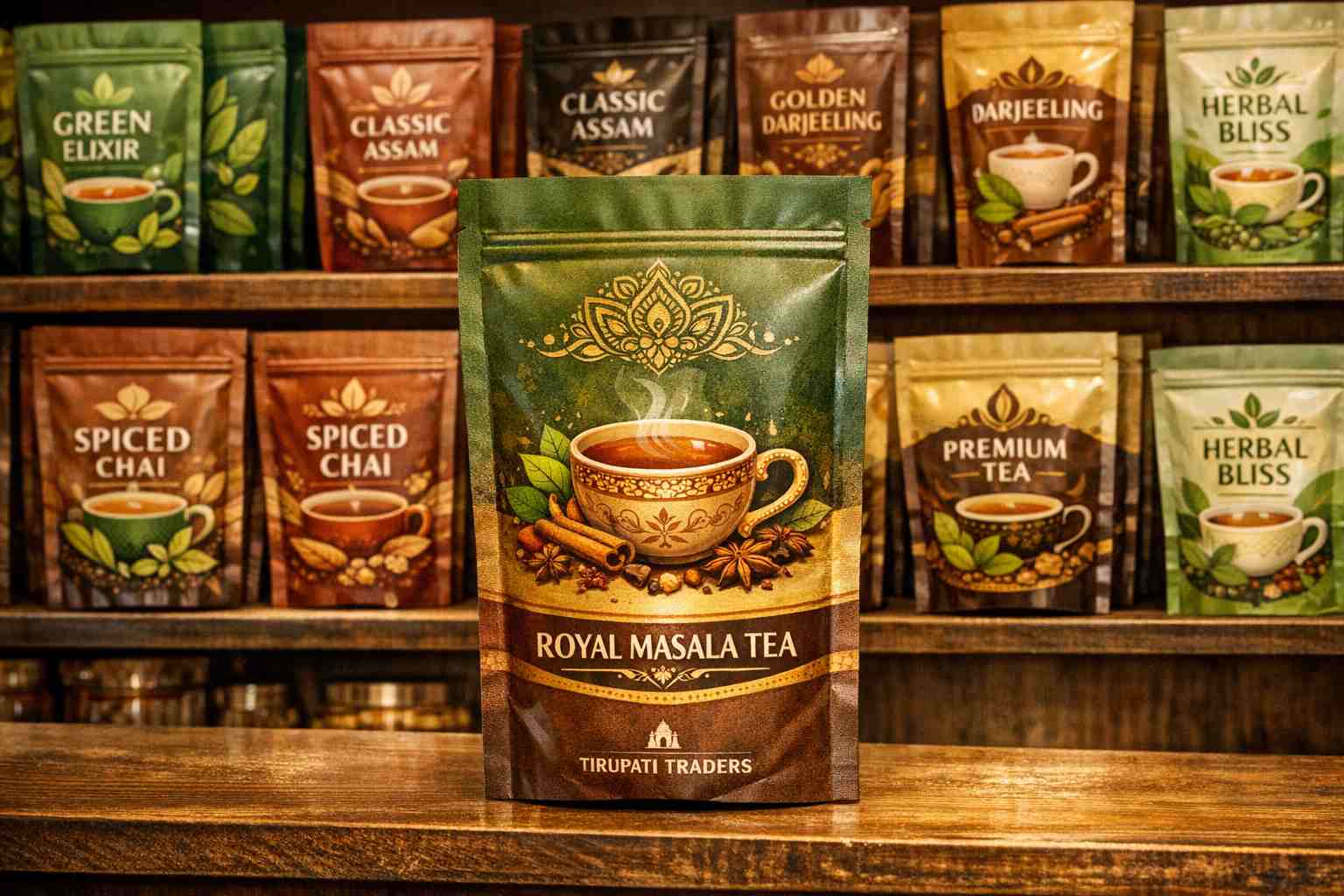
Running a successful business in India’s highly competitive FMCG, agro, and food manufacturing sectors demands more than just a great product. Whether you are dealing in farm-fresh produce or premium loose-leaf blends, how you pack and present your items plays a massive role in consumer trust. As a dedicated packaging manufacturer based in Kolkata, Tirupati Traders has witnessed firsthand how crucial packaging procurement is to a brand’s growth. One of the most vital yet often misunderstood aspects of this supply chain is the minimum production threshold, commonly known as the Minimum Order Quantity (MOQ).
We’ve had the privilege of partnering with esteemed names like Steps Tea, Aanchal Gold, Vizesa Tea, Hamza Spices, and Zaha Atta. Through these collaborations, we’ve learned that managing packaging volumes effectively is the secret to protecting your profit margins while ensuring top-tier product freshness and branding. This guide provides actionable, real-world insights for food manufacturers, pharma companies, and FMCG brands looking to optimize their custom plastic pouch procurement without tying up unnecessary capital.
Decoding the Minimum Batch Size: Why It Dictates Your Supply Chain
In the world of custom plastic pouch manufacturing, the minimum order threshold is simply the smallest number of units a supplier is willing to produce or sell at an agreed-upon price. These baseline limits are essential because setup costs—such as creating printing cylinders and calibrating machinery—require a certain volume to be financially viable.
For specialized items like multilayer barrier films, airtight foil wrappers, or custom-printed heat seal bags, the manufacturing complexity increases. A small business might initially find these bulk requirements intimidating due to tight cash flow and limited warehouse space. However, large-scale FMCG companies use these bulk volumes to unlock massive economies of scale. By understanding how these production minimums align with your raw material sourcing and seasonal demand, you can build a more resilient and efficient operational roadmap.
Core Elements Influencing Production Thresholds
Not all packaging materials are created equal, and similarly, their minimum order requirements vary significantly. Several ground realities dictate these limits in the Indian manufacturing landscape:
- Choice of Raw Material: High-end, moisture-resistant laminates, compostable films, and premium aluminum foils inherently require a larger minimum run due to the cost and sourcing of these specialized raw materials.
- Printing Technology Employed: If your brand demands vibrant, high-definition graphics, rotogravure printing is the industry standard. However, engraving the metallic cylinders for rotogravure mandates a higher initial run, often upwards of 150 kg minimum order quantity (MOQ). Conversely, digital printing caters beautifully to smaller trial runs but at a slightly higher per-unit cost.
- Structural Customizations: Adding user-friendly features like resealable zip locks, transparent gussets, tear notches, or unique die-cut shapes adds extra steps to the assembly line, subsequently raising the base volume required.
- Stringent Industry Regulations: Food-grade and pharma-grade packaging must comply with strict safety standards. The intensive sanitization and multilayer barrier processes required to meet these norms often push the initial volume threshold higher.
The Balancing Act: Upsides and Bottlenecks of Bulk Procurements
Committing to a bulk production run is a double-edged sword. When managed correctly, it is highly advantageous, but it demands smart financial planning.
The primary advantage is undeniable cost efficiency. Ordering in bulk drastically reduces your per-unit expenditure, allowing you to price your product more competitively on retail shelves. Furthermore, large runs guarantee absolute color and design consistency across all your packets, ensuring your brand looks professional and uniform. Fewer production runs also mean less industrial waste, aligning better with eco-friendly operational goals.
On the flip side, the challenges are equally real. A hefty upfront investment can temporarily lock up your working capital. Additionally, businesses must possess adequate, moisture-free storage facilities to hold this inventory without degrading the material over time. Forecasting errors could also lead to overstocking, which is risky if you decide to rebrand or change your product formulation.
Smart Tactics to Handle Bulk Production Needs
How do emerging food brands and agro-industries meet these manufacturing requirements without breaking the bank? Here are some strategies tailored for the Indian business ecosystem:
- Strategic Vendor Partnerships: Look for flexible manufacturers who offer tiered pricing. Building a long-term relationship often opens doors to staggered deliveries, where the supplier produces the bulk order but ships and bills it in scheduled phases.
- Test the Waters with Digital Prints: Before committing your capital to a massive rotogravure run, use digital printing for a limited market launch. This helps you gauge consumer reaction before fully scaling up.
- Precise Market Forecasting: Rely on your historical sales data and upcoming festive season trends to accurately predict your requirements. This prevents both dreadful stock-outs and expensive overstocking.
- Optimize Your Warehousing: Invest in smart shelving and inventory tracking systems so that your bulk packaging is stored safely, preserving its quality for months.
Understanding MOQs for Tea Packaging: What You Need to Know
Minimum Order Quantity (MOQ) is the smallest quantity a supplier requires you to purchase for a specific product. For tea packaging, understanding MOQs is essential for managing costs and inventory effectively. At Poojn, we specialize in providing high-quality packaging solutions tailored to your needs, including tea packaging.
Benefits of Choosing Poojn for Tea Packaging
- Customizable Options: We offer a variety of designs, materials, and sizes to meet your specific tea packaging requirements.
- Flexible MOQs: Our MOQs are designed to cater to both small and large businesses. For example:
- MOQ: 5 Kg for bulk packaging.
- MOQ: 100 Pieces for smaller, retail-ready pouches.
Learn more about high-quality tea packaging pouches here.
- Cost Efficiency: By understanding and choosing the right MOQ, you can reduce wastage and save on costs.
Why Choose Poojn?
- Quality Assurance: We ensure all our packaging solutions meet industry standards.
- Expert Guidance: Our team can help you choose the right packaging options and MOQs for your business.
- Quick Support: Contact us at +91 7003213441 for inquiries or assistance.
For more information about our products and services, visit Poojn.in.
Selecting the Perfect Batch Size for Your Operations
There is no one-size-fits-all answer when it comes to deciding your ideal packaging order. Your decision should be a calculated intersection of your current business scale, the specific demands of your product, and the shifting dynamics of the retail market.
If you are a boutique brand launching an artisanal spice mix or premium herbal blend, prioritizing operational flexibility over rock-bottom unit pricing makes sense. On the other hand, established FMCG powerhouses packing staples like pulses, detergents, or wholesale tea must leverage high-volume runs to maintain their razor-thin margins.
Common Clarifications Regarding Packaging Procurement
The concept of a minimum order threshold in packaging
It refers to the lowest number of custom pouches or bags a manufacturing partner will agree to produce in a single cycle. This metric ensures that the entire production process remains economically viable for the factory while delivering a competitive rate to the buyer.
The rationale behind supplier restrictions
Manufacturers enforce these baseline limits to successfully absorb heavy preliminary costs, such as graphic setup, printing cylinder creation, and machine calibration. Without a base volume, the factory would operate at a loss.
The impact on emerging and mid-sized businesses
Procuring large volumes can initially strain the cash reserves of smaller setups, forcing them to buy more than immediately necessary. However, this bulk commitment drastically lowers the cost per piece, paving the way for better profitability and long-term business stability.
Volume fluctuations for tailored designs
Custom-branded packaging undeniably commands a higher minimum threshold compared to plain, unprinted stock bags. The integration of specialized metallic inks, brand-specific typography, and customized structural shapes requires dedicated assembly line adjustments, naturally pushing the initial volume requirement higher.
Strategies to negotiate better terms with factories
Many B2B manufacturers are open to negotiation if you offer a commitment to long-term collaboration. Opting for universally standard pouch sizes, minimizing the number of print colors, or agreeing to a steady, year-long procurement contract can often persuade suppliers to lower their initial hurdles.
The ultimate value of intelligent volume management
A thorough grasp of order thresholds is non-negotiable for smart financial forecasting. It empowers food and agro-businesses to synchronize their packaging inventory with their actual sales velocity, successfully avoiding the twin pitfalls of capital-draining overstock and brand-damaging material shortages.
Final Thoughts: Making Smart Procurement Decisions
Mastering the dynamics of minimum manufacturing volumes is an ongoing journey that can elevate your entire supply chain. By meticulously evaluating the intricacies of print technologies, material grades, and the capabilities of your manufacturing partners, you can perfectly align your packaging inventory with your overarching growth objectives.
At Tirupati Traders, our goal has always been to simplify this complex process for Indian businesses. Whether you are scaling a regional FMCG brand, an emerging agro-company, or a legacy food manufacturing firm, finding the sweet spot between premium quality, cost-efficiency, and operational flexibility is totally achievable. Partner with reliable experts, anticipate your market demand, and let your packaging serve as the strongest silent salesperson for your brand.