

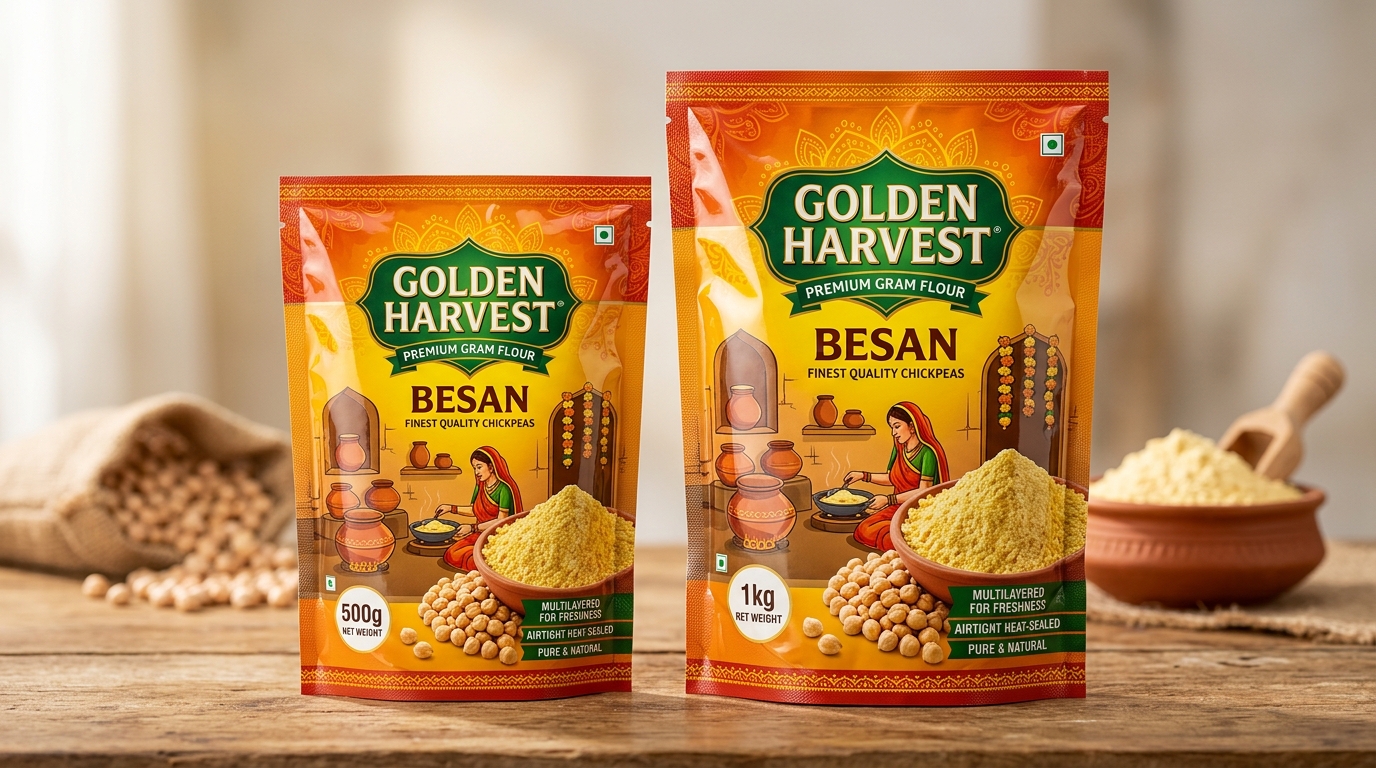
For pulse millers, dal processing units, and FMCG food brand owners across Kolkata, West Bengal, and Eastern India, packaging milled chickpea flour (Besan) and roasted gram flour (Sattu) presents a unique set of packaging engineering challenges. Unlike whole grains, milled pulses are hygroscopic, contain volatile natural fats vulnerable to lipid oxidation, and produce ultra-fine powder dust that can disrupt high-speed automated packaging lines.
When B2B brand owners evaluate 500gm besan pouches and 1kg besan packaging rolls, choosing the correct multi-layer laminated barrier film, micron thickness, and heat-seal polymer is the difference between fresh, aromatic flour on the retail shelf and costly product returns due to moisture clumping, weevil infestation, or ruptured seals.
In this technical procurement guide, Tirupati Traders breaks down the material physics, layer structures, sealing chemistries, and batch yield calculations essential for ordering custom-printed 500g and 1kg besan packaging pouches.
1. The Granular Physics of Besan: Why Standard Poly Bags Fail
Besan (gram flour) consists of finely milled Cicer arietinum (Bengal gram/chana dal), characterized by fine particle distribution (typically 80–120 mesh) and an inherent fat content of approximately 5% to 6%. These properties create four critical packaging hazards:
- Moisture Ingress & Caking: Dry besan rapidly absorbs ambient atmospheric moisture. In humid climates across Eastern India, even minor water vapor transmission through single-layer poly causes hard lump formation (caking) and sour microbial fermentation.
- Lipid Rancidity & Flavor Loss: Chickpea fats oxidize when exposed to ambient oxygen and UV light, leading to off-flavors, bitterness, and loss of the signature nutty roasted aroma.
- Fine Powder Dust Seal Contamination: During automated vertical form-fill-seal (VFFS) or manual funnel filling, fine flour dust floats onto the sealing lip. If the packaging film lacks a high-tack, low-initiation-temperature inner sealant, the dust prevents thermal fusion, causing micro-channel leaks.
- Insect & Weevil Infestation: Grain pests (such as flour beetles / Tribolium castaneum) can bore through thin, unlaminated low-density films. A tough, multi-layer laminated barrier is non-negotiable for retail shelf life beyond 90 days.
2. Multi-Layer Laminated Film Structures for Besan & Sattu
To ensure 100% moisture protection, puncture resistance, and print brilliance, besan packaging must utilize co-extruded or adhesive-laminated flexible barrier films. Depending on shelf-life targets and retail distribution tier, two primary laminations dominate the FMCG landscape:
Structure A: Standard 2-Ply Lamination (PET + Natural LDPE)
- Layer Composition: 12 Micron Polyester (PET) + 55 to 65 Micron Food-Grade Natural Polyethylene (LDPE).
- Total Thickness: 67 to 77 Microns.
- Target Shelf Life: 4 to 6 months in standard retail grocery environments.
- Primary Advantages: High tensile strength, crystal-clear reverse rotogravure print fidelity, puncture resistance, and cost-effective unit pricing. Excellent for fast-moving 500g and 1kg retail packs with quick market turnover.
Structure B: High-Barrier 3-Ply Metallized Lamination (PET + MET-PET + LDPE)
- Layer Composition: 12 Micron PET + 12 Micron Metallized PET (MET-PET) + 50 to 60 Micron Virgin LDPE.
- Total Thickness: 74 to 84 Microns.
- Target Shelf Life: 9 to 12 months.
- Primary Advantages: Near-zero Water Vapor Transmission Rate (WVTR) and Oxygen Transmission Rate (OTR). Metallized barrier reflects 99% of visible and UV light, stopping fat rancidity in roasted sattu and premium aromatic besan blends.
3. Pouch Formats: Why Center-Seal (Pillow Pouch) Dominates the Besan Market
Flexible packaging for 500g and 1kg dry staples comes in distinct physical configurations:
| Pouch Format | Structural Characteristics | Best Suited Application |
|---|---|---|
| Center-Seal (Pillow Pouch) | Vertical back fin seal with top and bottom cross-seals. Delivers symmetrical volume expansion and 100% unobstructed front display area for brand artwork. | Primary Standard for 500g & 1kg retail flour, besan, maida, and sattu packing across India. |
| Three-Side Seal Pouch | Sealed on left, right, and bottom edges with top open for filling. Provides flat, rigid profile with clean perimeter borders. | Ideal for smaller trial packs (100g, 200g seasoning/batter mixes) or institutional sample kits. |
| Continuous Printed Roll Stock | Continuous multi-layer printed web wound on cores with precise eye-mark registration. | High-speed automated VFFS continuous packing lines operating at 40–80 pouches/minute. |
Note: Tirupati Traders specializes in custom-printed Center-Seal and 3-Side Seal multi-layer laminated pouches and automated roll stock. We do not manufacture unprinted plain bags or unsupported zipper/standee formats.
4. Technical Engineering Matrix: 500g vs 1kg Pouch Specifications
The following engineering parameters represent standard industry benchmarks for gram flour packaging:
| Technical Parameter | 500g Besan Center-Seal Pouch | 1kg Besan Center-Seal Pouch |
|---|---|---|
| Typical Finished Dimensions | 160 mm (W) × 230 mm (H) | 200 mm (W) × 290 mm (H) |
| Recommended Total Micron | 65 – 75 Microns | 75 – 90 Microns |
| Substrate Combination | 12µ PET + 55µ LDPE (or 12µ PET + 12µ Met-PET + 45µ LDPE) | 12µ PET + 70µ LDPE (or 12µ PET + 12µ Met-PET + 60µ LDPE) |
| Average Tare Weight per Empty Pouch | Approx. 6.5 – 7.2 grams | Approx. 10.5 – 11.8 grams |
| Dart Impact Drop Resistance | Passes 1.2 m free-fall burst test | Passes 1.5 m free-fall burst test |
| Seal Initiation Temperature (SIT) | 110°C – 125°C | 115°C – 130°C |
5. Solving Powder Dust Seal Contamination on Automated Lines
One of the most frequent technical complaints among dal millers is channel leaks at the cross-seal. When filling vertical auger packers drop fine besan flour, electrostatic airborne dust coats the inside poly layer right as sealing jaws clamp shut.
At Tirupati Traders, we resolve this through specialized sealant film engineering:
- Low SIT Sealant Resins: We formulate the inner LDPE layer with specialized metallocene or linear low-density resins (mLLDPE) that initiate thermal bonding at lower temperatures before powder charring occurs.
- High Hot-Tack Strength: The molten poly flows under sealing jaw pressure, displacing and encapsulating airborne starch and protein particles into the polymer matrix to create a continuous, hermetic seal.
- Anti-Static Additives: Food-grade slip and anti-static masterbatches prevent electrostatic cling of dry besan powder to the pouch mouth during discharge.
6. MOQ Economics & Batch Yield Calculations (150 kg Batch)
All production at Tirupati Traders operates on a custom-manufactured basis with a Minimum Order Quantity (MOQ) of 150 kg. Understanding the relationship between film weight, micron thickness, and pouch yield is vital for cost forecasting:
Formula for Pouch Yield:
Total Pouches = (Total Order Batch Weight in Grams) / (Tare Weight of Individual Pouch)
Batch Yield Estimates per 150 kg Minimum Order:
- 500g Besan Center-Seal Pouch (68 Microns, ~6.8g per pouch):
150,000 g ÷ 6.8 g ≈ 21,500 – 22,000 Finished Pouches - 1kg Besan Center-Seal Pouch (80 Microns, ~10.8g per pouch):
150,000 g ÷ 10.8 g ≈ 13,800 – 14,200 Finished Pouches
Rotogravure Printing Cylinders: High-precision electronically engraved copper cylinders are manufactured per color (up to 8 colors). These cylinders remain your brand’s dedicated property and are reused for all future production runs without recurring tooling expenses.
7. FSSAI Regulatory & Food Safety Standards
Every food packaging batch produced by Tirupati Traders complies strictly with FSSAI (Food Safety and Standards Authority of India) Packaging Regulations:
- Zero Solvent Retention: Manufactured using state-of-the-art solvent-free lamination adhesives, ensuring zero residual chemical odor or migration into dry food products.
- Virgin Polymer Certification: Only 100% prime virgin food-grade PE granules are utilized for the product contact layer.
- Statutory Labeling Clearances: Artwork layouts allocate clear, standardized panels for FSSAI License numbers, nutritional facts, batch coding, MRP print windows, and mandatory green vegetarian symbols.
8. Frequently Asked Questions (B2B Procurement FAQs)
Q1: Can I use the same laminated roll for both 500g Besan and 500g Sattu?
Yes. If your pouch dimensions and sealing parameters match, the barrier properties of PET/LDPE or PET/MET-PET/LDPE are equally effective for gram flour (besan) and roasted gram flour (sattu). However, statutory FSSAI ingredient disclosures must reflect each specific commodity.
Q2: Why should I choose 3-ply metallized over 2-ply transparent packaging?
If your distribution cycle extends beyond 4 months or reaches warm retail storefronts exposed to direct sunlight, the metallized PET barrier layer prevents oil rancidity and flavor fade, guaranteeing a crisp, fresh aroma upon customer opening.
Q3: What is the turnaround time for a new custom-printed besan pouch order?
New cylinder engraving and pilot proofing require approximately 7 to 10 working days. Subsequent reorders from existing cylinders are processed and dispatched within 5 to 7 business days from our Kolkata plant.
Partner with Kolkata’s Trusted FMCG Packaging Manufacturer
Whether you are launching a new regional flour brand or scaling up automated packaging for high-volume pulse milling, Tirupati Traders delivers custom-printed, high-barrier packaging engineered for maximum shelf life and zero line stoppages.
- Facility Address: 35, Maulana Saukat Ali St, Colootola, Tiretti, Kolkata, West Bengal 700073
- Direct Phone & WhatsApp: +91 70032 13441
- Explore Full Product Range: Tirupati Traders Product Offerings
- Request a Fast B2B Quotation: Contact Our Sales Engineering Team